




What is the weight of a metal mesh cage?
 Oct 21, 2025|
 Hey there! As a supplier of Metal Mesh Cages, I often get asked one question: "What is the weight of a metal mesh cage?" Well, let's dive right into it and break down all the factors that affect the weight of these nifty cages.
First off, what exactly is a Metal Mesh Cage? You can check out more details about it Metal Mesh Cage. These cages are made from metal wires that are welded or woven together to form a grid-like structure. They're used in a wide range of applications, from animal enclosures to industrial storage and even in some construction projects.
The weight of a metal mesh cage isn't a one - size - fits - all kind of thing. There are several key factors that play a role in determining how heavy it will be.
Material
The type of metal used is a major factor. Common materials for metal mesh cages include steel, stainless steel, and aluminum. Steel is a popular choice because it's strong and relatively inexpensive. However, it's also quite heavy. Stainless steel, on the other hand, is more resistant to corrosion but can be a bit pricier. Aluminum is lightweight and corrosion - resistant, making it a great option for applications where weight is a concern, like in some portable enclosures.

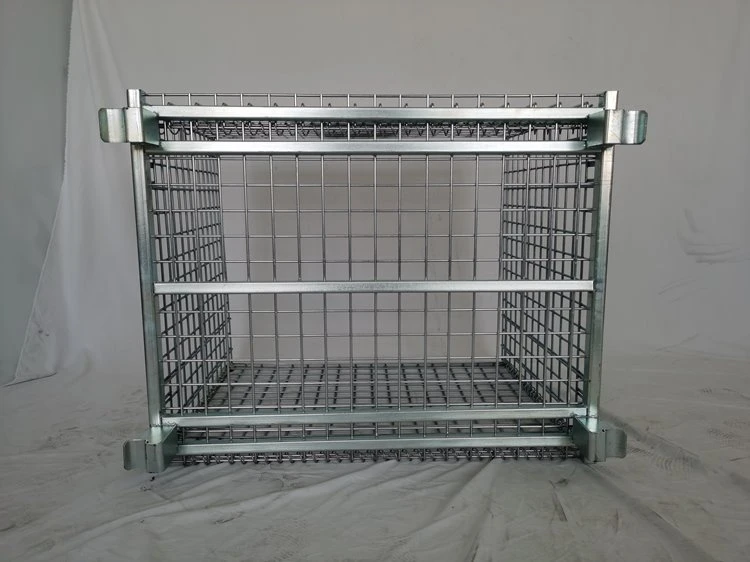
Let's say we have two cages of the same size. One is made of steel and the other of aluminum. The steel cage is going to be significantly heavier. For instance, steel has a density of around 7.85 g/cm³, while aluminum has a density of about 2.7 g/cm³. That means for every cubic centimeter of material, steel weighs almost three times as much as aluminum.
Wire Gauge
The wire gauge is another crucial factor. The gauge refers to the thickness of the wire used in the mesh. A lower gauge number means a thicker wire. Thicker wires are stronger but also heavier. If you're using a cage for heavy - duty applications, like holding large animals or storing heavy equipment, you'll probably want a lower - gauge wire. But if weight is a major consideration, you might opt for a higher - gauge (thinner) wire.
For example, a cage made with 6 - gauge wire will be much heavier than one made with 12 - gauge wire, even if they have the same dimensions and mesh pattern.
Mesh Size
The size of the openings in the mesh also affects the weight. A cage with smaller mesh openings will generally be heavier because it requires more wire to create the same surface area. Larger mesh sizes use less wire, resulting in a lighter cage.
Suppose you have two cages of identical dimensions. One has a mesh size of 1" x 1", and the other has a mesh size of 2" x 2". The cage with the 1" x 1" mesh will have more wire and thus be heavier.
Cage Dimensions
This one's pretty obvious. A larger cage will weigh more than a smaller one, all other factors being equal. The more material you use to build the cage, the heavier it will be. If you're building a cage for a small pet, you can get away with a smaller, lighter cage. But for a large livestock enclosure, you'll need a much bigger and heavier cage.
Let's do some quick math to illustrate this. If we have a simple rectangular cage with length (L), width (W), and height (H), the amount of wire used is proportional to the perimeter and the number of internal supports. Doubling the length, width, and height of a cage will increase its weight significantly.
Calculating the Weight
To get a rough estimate of the weight of a metal mesh cage, you can use some basic calculations. First, you need to know the volume of the wire used. You can calculate the surface area of the mesh and then multiply it by the cross - sectional area of the wire. Once you have the volume, you multiply it by the density of the metal.
Let's say we have a steel mesh cage with a wire gauge of 10, a mesh size of 1.5" x 1.5", and dimensions of 3 feet by 2 feet by 2 feet. We can calculate the length of the wire used by considering the number of horizontal and vertical wires in the mesh. Then, using the density of steel (7.85 g/cm³), we can estimate the weight.
However, these calculations can get quite complex, especially for cages with irregular shapes or multiple layers of mesh. That's why it's often easier to consult with a professional or refer to the manufacturer's specifications.
Applications and Weight Considerations
In different applications, the weight of the metal mesh cage can have different implications.
Animal Enclosures
For small animals like rabbits or guinea pigs, a lightweight cage made of higher - gauge wire might be sufficient. It's easy to move around and clean. But for larger animals like dogs or livestock, a heavier, more durable cage made of lower - gauge wire is necessary to ensure the safety of the animals and prevent them from escaping.
Industrial Storage
In industrial settings, cages are used to store tools, equipment, and even bulk materials. Here, the weight of the cage needs to be balanced with its strength and capacity. A cage that's too light might not be able to hold heavy items without deforming, while a cage that's too heavy can be difficult to move and install.
Construction
In construction projects, metal mesh cages can be used as formwork or reinforcement. Lightweight cages made of aluminum or high - strength, thin - gauge steel can be more easily installed and maneuvered on the construction site.
Related Products
If you're interested in other related products, we also offer Mineral Processing Screens and Welded Wire Screen. These products have their own unique characteristics and applications, and the weight also plays an important role in their performance.
Conclusion
So, as you can see, the weight of a metal mesh cage depends on a variety of factors, including the material, wire gauge, mesh size, and cage dimensions. Whether you need a lightweight cage for a portable application or a heavy - duty cage for a tough environment, there's a solution out there for you.
If you're in the market for a metal mesh cage or have any questions about weight, size, or material, don't hesitate to reach out. We're here to help you find the perfect cage for your needs. Let's start a conversation and figure out the best option for you.
References
- "Metals Handbook: Properties and Selection: Irons, Steels, and High - Performance Alloys", ASM International
- "Materials Science and Engineering: An Introduction", William D. Callister Jr. and David G. Rethwisch